How Much Does a Shepherd’s Hut Cost? A Complete Guide
Right, let’s tackle the question everyone wants answered, but nobody seems to explain properly: what does a shepherd’s hut actually cost, and more importantly, why?
We’ve been building these things for years now, and we still get customers absolutely gobsmacked when they realise there’s a bit more to budgeting than just the hut price. So let’s break it all down properly, shall we? No flannel, no sales pitch – just the honest truth about what you’re spending your money on.
The Price Range (And Why It’s Massive)
Shepherd’s huts in the UK run anywhere from £5,000 to £120,000+. Yes, really. And no, that’s not a typo!
Here’s the thing though, comparing a £5,000 shell to a £50,000 luxury hut is like comparing a tent to a proper cottage. They’re barely the same product. One’s four walls and a door, the other’s a fully-fitted space you could genuinely live in. So when someone says “I’ve seen them for five grand online,” we have to gently explain that what they’ve seen and what they’re actually after are probably worlds apart.
What Actually Drives the Cost? (The Stuff Nobody Tells You)
Build Quality – Or, Why Cheap Becomes Expensive
Look, we could slap together a hut using the cheapest timber we could find, cut a few corners on the chassis, and have it out the door for half what we charge. But you’d be calling us in two years when the cladding’s warped, the frame’s twisted, and the whole thing looks like it’s been through a war.
Proper construction using seasoned hardwood costs more upfront, but you’re buying something that’ll still be standing strong in thirty years. We use timber that’s been properly treated and dried because we’ve seen what happens when you don’t, and trust us, it’s not pretty.
The chassis alone makes a massive difference. A properly engineered steel frame with correct load distribution isn’t cheap, but it means your hut won’t sag, crack, or turn into a wonky nightmare the first time you need to move it.
So instead of asking how much does a shepherd’s hut cost, we should be asking how much would it cost if we had to do it twice?
Materials – Where Your Money Really Goes
External cladding is where a lot of the magic happens, budget-wise. You can use basic pine and save a few quid, or you can use larch or cedar that’ll weather beautifully and actually protect your investment. We’re not snobs about it, some people genuinely don’t need premium materials – but when someone comes to us five years later saying their cheap cladding is splitting and rotting, well… we did try to warn them.
The windows and doors situation always makes people blink. You can have UPVC units that look like they belong on a council house, or you can have proper timber casement windows with decent ironmongery that actually suit the aesthetic. It’s not even about being fancy, it’s about the hut looking how you imagined it, not like a garden shed that’s ideas above its station.
And can we talk about glazing for a second? Single glazing is essentially useless for anything beyond a summer shed. Double glazing transforms the space into somewhere you’d actually want to spend time in February. Triple glazing? Now we’re talking proper comfort, though you pay for the privilege.
Size – It’s Not Just About Square Feet
Everyone assumes bigger automatically means proportionally more expensive. It doesn’t work quite like that. A 18ft hut doesn’t cost twice as much as a 9ft one because loads of the expensive bits (chassis, wheels, doors, the time-consuming faffy bits) don’t scale with size.
Where it gets really interesting is when people want multiple huts joined together. That’s our bread and butter, actually, creating these larger spaces by connecting two or even three huts. But the engineering, the weatherproofing where they join, the additional complexity… yeah, that’s when prices climb. Worth it though, if you need the space.
What Goes Inside – This Is Where It Gets Expensive
An empty shell is just that, four walls, a roof, maybe some insulation if you’re lucky. The moment you start talking about actually using the space, the costs balloon.
Basic electrical work means a few sockets and lights. Proper electrical installation means multiple lighting zones, all the mod cons you’d expect in a house. Every socket, every switch, every circuit – it all adds up, and it all needs certifying properly.
Plumbing’s even worse. A cold tap for a basic sink? Fairly straightforward. Full hot water system with a pressurised shower, toilet with macerator, waste management that actually works? That’s a different beast entirely. And the quality of these installations is what separates a hut you love from one you’re constantly cussing at.
Bespoke vs. Off-the-Peg
Standard designs let us work efficiently, we know exactly what materials to order, we’ve built that layout before, there are no surprises. That efficiency means lower costs for you.
Bespoke work is where Karly really comes into her own (she’ll kill me for saying this, but she’s properly obsessive about getting details right). Custom designs mean we’re working from scratch, ordering one-off materials, figuring out solutions to your specific requirements. It takes longer, costs more, but you get exactly what you want rather than making do with something close-ish.
The Price Bands Explained (What You Actually Get)
£5,000–£20,000: The Basic Shell
This is the “I just want four walls” option. Timber structure on a chassis, some windows, a door, maybe basic insulation. The inside’s usually bare plywood or tongue-and-groove if you’re lucky.
What you get: A weatherproof structure that looks like a shepherd’s hut.
What you don’t get: Literally anything that makes it functional – no electrics, no plumbing, no finished interior.
Honestly, unless you’re handy and planning to fit it out yourself, or you genuinely just need a posh shed, the completed hut shell only probably isn’t what you’re after. Most people who start here end up wishing they’d spent more from the beginning.
£20,000–£35,000: The Actually Usable Hut
This is where it starts getting interesting. Proper insulation throughout, full electrical installation, finished interior, decent flooring. You could actually work in here year-round without freezing or melting.
What’s included: Everything from the basic shell plus insulation that actually works, complete wiring with sockets and lights, finished walls and ceiling (no more looking at bare plywood), quality flooring, built-in furniture, better windows, and proper exterior finish.
What’s not: Any plumbing or water, bathroom facilities, or kitchen beyond maybe space for a kettle.
This is perfect for garden offices, guest rooms where people use your main house bathroom, or hobby spaces. It’s also where a lot of glamping operators start if they’re providing shared facilities for guests.
£35,000–£60,000: The Proper Living Space
Right, now we’re into genuine habitable territory. This is where the hut stops being a fancy shed and starts being more like a tiny house.
You’re getting everything from the mid-range plus proper plumbing (hot and cold), a functional kitchen with appliances, a bathroom with shower (or a compact bath if there’s room), toilet with waste system, heating that actually keeps you warm, and fixtures that don’t look like they came from the bargain bin.
This is what most glamping businesses need if they want self-contained units. It’s also perfect for annexe accommodation, holiday lets, or if you’re genuinely planning to live in the thing while you sort out your main house.
£60,000–£120,000+: The “Blimey, That’s Fancy” Category
This is where we really get to show off, if we’re honest. Completely bespoke designs, premium everything, and often multiple huts joined together to create something spectacular. This is “wow” on steroids!
We’re talking copper fixtures, designer tiles, hardwood flooring, luxury bathroom fittings, proper kitchens with high-end appliances, statement fireplaces, integrated sound systems… The works. And then there are the outdoor additions – hot tubs, saunas, wraparound decking.
We’ve done some absolutely crackers at this end of the market. The glamping operators working at this level are charging serious money per night and need their huts to justify it. These aren’t just places to sleep – they’re destinations.
The Costs Everyone Forgets (And Then Panics About)
Ground Prep – Not Optional, Despite What People Hope!
Your hut needs to sit on something, and “the grass, probably?” isn’t the answer we’re looking for.
At the very least, you need a compacted hardcore base with gravel – figure £500 to £1,500. It’s not glamorous, but it stops your hut from slowly sinking into the mud over winter.
Most people need a proper concrete base though. Either a full slab or individual pads under the wheels and support points. This ensures everything stays level, stops the chassis rotting and prevents the whole thing from settling unevenly (which causes all sorts of grief).
Budget £1,500–£4,000 depending on size.
Got a slope? Of course you have. Everyone’s got a slope. Dealing with it properly, excavation, retaining walls, creating a level platform – can easily add £3,000–£8,000+. But the alternative is pretending you don’t have a slope and then wondering why your hut’s rolling away.
Getting It There – The Access Question
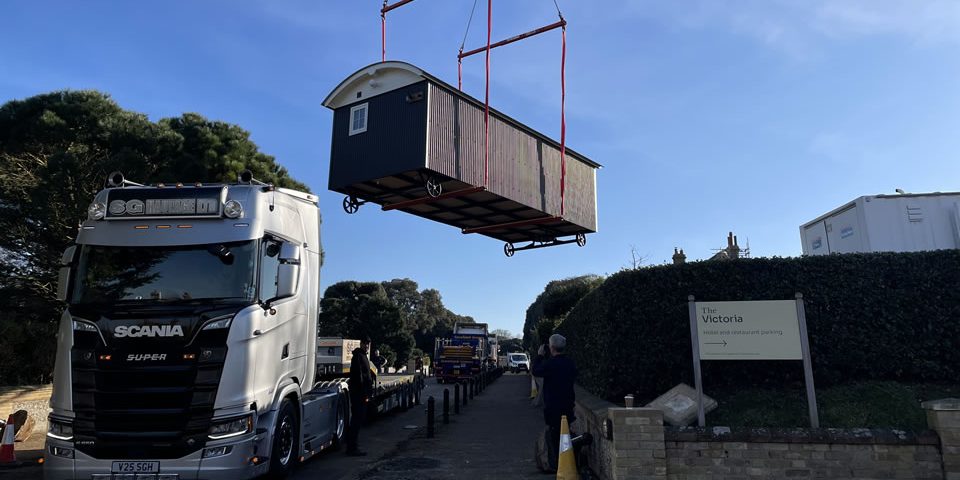
Delivery trucks are big. The hut on the back is even bigger. Together, they need wide driveways, sensible turning circles, and no overhanging trees trying to decapitate the whole affair.
Normal access? Usually fine, delivery’s straightforward. Narrow country lane with a 90-degree bend? Now we need to have a chat about cranes, smaller trucks, or possibly just accepting that your dream location isn’t physically possible. These special arrangements can add £1,000–£5,000 easily.
We always insist on a site visit before confirming delivery. We’ve seen enough “yeah, access is fine” situations turn into “ah, perhaps I should have mentioned the medieval bridge” nightmares.
Utilities – The Expensive Bit Everyone Minimizes
If your hut needs power, water, or waste management (and if it’s more than a basic shell, it definitely does), connecting these services is your next adventure in spending money.
Electrical connection involves burying armored cable from your house, proper distribution boards, and certification. Straightforward run of 20–30 meters? £800–£2,000. Anything more complicated and the price climbs accordingly.
Water supply means trenching, pipe laying, and potentially pumps if you’re far from the main supply or dealing with elevation changes. Cold water might cost £1,000–£2,500. Full hot water capability costs more.
But waste management – this is where it gets properly expensive. Near existing drains? £2,000–£4,000 for connection. Middle of nowhere? You’re looking at septic tanks (£3,000–£6,000), treatment plants (£4,000–£8,000), or macerator systems (£1,500–£3,500). Nobody ever budgets enough for this bit.
Planning Permission – Maybe, Maybe Not
Most shepherd’s huts benefit from permitted development rights, which is planning-speak for “you probably don’t need permission.” But, and there’s always a but, that depends on where you’re putting it, how close to boundaries, whether you’re in a conservation area, and what you’re using it for.
If you do need planning permission, budget £500–£1,500 for applications and drawings. Building regulations are usually not an issue for huts used incidentally to your main dwelling, but if you’re creating commercial hospitality units or permanent accommodation, they might apply. Compliance costs money.
What to Think About Before You Buy
Be Honest About How You’ll Use It
We see a lot of people over-specify because they imagine they’ll use every feature, then half of it sits unused. We also see people under-specify and end up miserable because they’re freezing in January.
If you need year-round use, proper insulation and heating aren’t negotiable. If it’s genuinely just for summer, you can save thousands by not specifying for winter use. Just be honest with yourself about which category you’re in.
Space Is Deceptive
Shepherd’s huts look bigger in photos than they feel in person. Before you commit, mark out the dimensions on your lawn with stakes and string, then stand in that space. It’s remarkable how different it feels.
Consider ceiling height too – those lovely curved roofs look charming but they reduce usable space at the edges. If you’re tall or planning to install kitchen units along the walls, check you’ve actually got the standing space you need.
Quality Indicators That Actually Matter
When you’re comparing quotes (and you should absolutely get multiple quotes), look beyond the bottom line.
Ask about timber thickness – external cladding should be at least 19mm, structural framing 50mm minimum. Find out what species of timber they’re using and how it’s treated. Look at the window and door quality, try them yourself if you can. Ask what grade of insulation they’re using.
Good manufacturers will tell you all this without being asked because they’re proud of their materials. Vague answers or reluctance to specify exact materials? That’s a red flag right there.
The Long Game
A well-built hut using quality materials will last 30–50 years with reasonable maintenance. Cheap construction might look similar when it’s delivered, but five years later when the cladding’s failing and the chassis is rusting, the price difference won’t seem quite so appealing.
We’ve repaired enough bodge jobs from cheap manufacturers to have strong opinions about this. The cheapest quote usually becomes the most expensive over the hut’s lifetime.
Final Thoughts
Buying a shepherd’s hut is a significant investment, and you deserve to understand exactly where your money’s going. From the timber quality and construction methods through to the site preparation and utility connections nobody mentions in their flashy brochures – it all matters.
Take your time. Visit our completed examples. Talk to our previous customers. Ask us awkward questions about materials and construction methods.
Any manufacturer worth their salt will be happy to explain their choices and show you why their hut costs what it does.
And for the love of all that’s holy, get your site properly assessed before you commit to anything. We’ve seen too many beautiful huts that couldn’t be delivered because someone assumed access would be fine without actually checking.
Done properly, your shepherd’s hut can be absolutely brilliant, a functional, beautiful space that serves you well for decades. Done cheaply or without proper planning, it becomes an expensive lesson in why shortcuts aren’t worth taking.
Now, who’s putting the kettle on?